Introduction
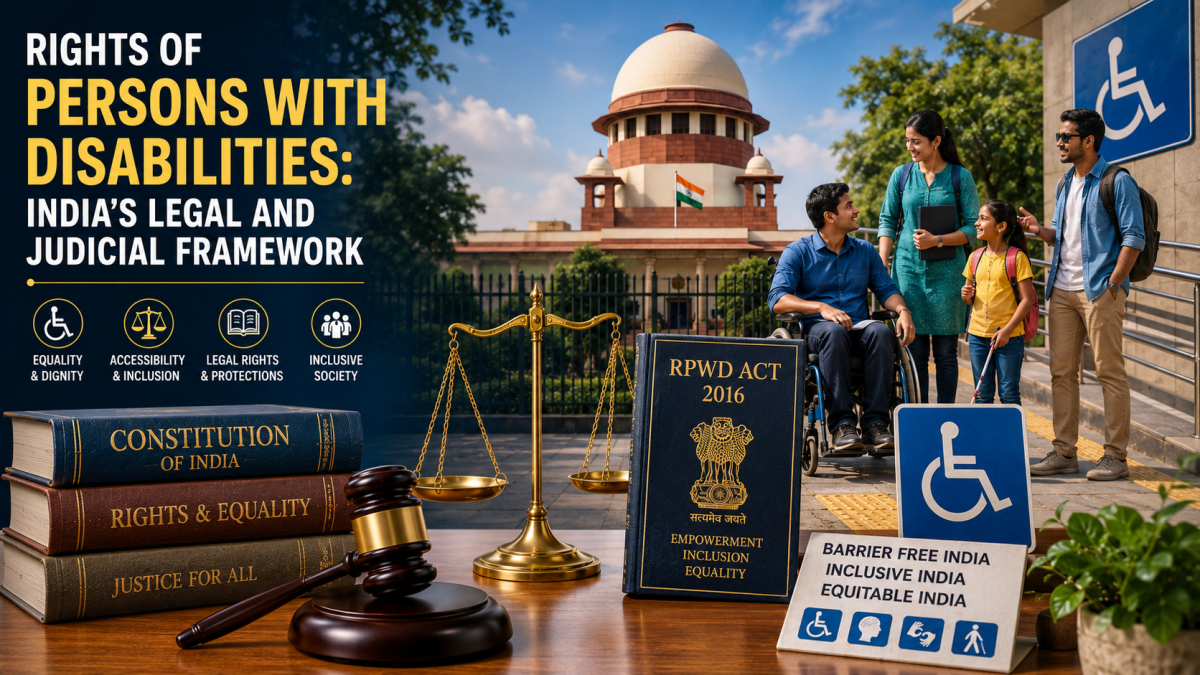
The rights of persons with disabilities occupy a central place in India’s constitutional and statutory framework. The Constitution guarantees equality and non-discrimination to all citizens, and these principles have been extended by judicial interpretation and legislation to protect the rights of persons with disabilities in education, employment, public life, and access to justice. India is also a signatory to the United Nations Convention on the Rights of Persons with Disabilities (UNCRPD), which has influenced the domestic legislative and judicial framework.
The Rights of Persons with Disabilities Act, 2016 (RPWD Act) replaced the earlier Persons with Disabilities (Equal Opportunities, Protection of Rights and Full Participation) Act, 1995 and significantly expanded the scope of disability rights in India. The Act adopts a social model of disability, recognizing that disability is the result of interaction between impairment and attitudinal and environmental barriers, rather than an individual medical condition. This article examines the legislative framework, judicial developments, and ongoing challenges in the domain of disability rights in India.
The Rights of Persons with Disabilities Act, 2016
The RPWD Act expanded the definition of disability from seven categories under the 1995 Act to twenty-one categories, including a new category of benchmark disability (persons with at least 40% disability) and specified disabilities including autism, cerebral palsy, mental illness, learning disabilities, and multiple disabilities. The Act guarantees equal opportunities and prohibits discrimination against persons with disabilities in education, employment, and access to public facilities.
The Act provides for reservation of 4% in government employment for persons with benchmark disabilities, accessible infrastructure in public buildings, educational institutions, and transportation, and the establishment of special courts for the speedy trial of offences against persons with disabilities. It also mandates the appointment of State Commissioners for Persons with Disabilities and the Chief Commissioner for Persons with Disabilities at the Central level as grievance redressal authorities.
Education Rights: Inclusive Education in Practice
The right to inclusive education for persons with disabilities is guaranteed under both the RPWD Act and the Right to Education Act. Courts have been called upon to enforce the right of children with disabilities to attend mainstream schools and to receive appropriate support and accommodations. In Disabled Rights Group v. Union of India (2018), the Supreme Court issued comprehensive directions for the implementation of inclusive education for children with disabilities, including the installation of ramps, barrier-free infrastructure, and the training of teachers in special education.
The Supreme Court and High Courts have also addressed the issue of accommodations in competitive examinations for persons with disabilities. Courts have consistently held that reasonable accommodations — such as the grant of extra time, the use of scribes, and access to assistive technology — are not a matter of charity but a right rooted in the principles of equality and non-discrimination. The denial of such accommodations to eligible candidates has been held to violate their fundamental rights.
Employment Rights and Reservation
The reservation of 4% in government employment for persons with benchmark disabilities is one of the key provisions of the RPWD Act. Courts have been called upon to enforce this reservation and to ensure that it is carried over and filled in subsequent years if vacancies are not filled. The Supreme Court in Rajeev Kumar Gupta v. Union of India (2016) held that the reservation for persons with disabilities is not merely a statutory privilege but a constitutional obligation flowing from Article 16 of the Constitution, which guarantees equality of opportunity in public employment.
High Courts have also addressed the issue of post-appointment discrimination against employees who develop disabilities during service. Courts have held that an employee who acquires a disability during service cannot be dismissed or penalized solely on account of the disability and must be provided with reasonable accommodation to continue in employment. The principle of reasonable accommodation — adapting the work environment to the needs of the disabled employee — has been increasingly recognized as a constitutional and statutory obligation of employers.
Accessibility and Barrier-Free Environment
Access to public spaces, buildings, transportation, and information technology is a prerequisite for the full participation of persons with disabilities in social, economic, and civic life. The RPWD Act mandates the creation of barrier-free environments in public buildings, educational institutions, transportation systems, and digital platforms. Courts have issued numerous orders directing governments and public bodies to ensure accessibility for persons with disabilities.
The Supreme Court in Rajive Raturi v. Union of India (2018) passed comprehensive directions for making public spaces and transportation accessible to persons with visual impairments, including measures for pedestrian infrastructure, public transport, and digital accessibility. Despite these judicial interventions, the implementation of accessibility standards in India remains uneven and slow, reflecting the gap between legal rights and practical reality for persons with disabilities.
Mental Health and Legal Rights
The Mental Healthcare Act, 2017 represents a landmark reform in the legal framework governing mental health in India. The Act recognizes mental illness as a health condition entitled to the same quality of care as physical illness and establishes the right of every person to access mental healthcare facilities run or funded by the government. The Act also decriminalizes the attempt to commit suicide by persons suffering from mental illness, reflecting the understanding that such attempts are primarily a manifestation of mental distress rather than a criminal act.
Courts have been called upon to enforce the rights of persons with mental illness to humane treatment, adequate facilities, and protection from arbitrary detention in mental health facilities. The Supreme Court has expressed concern about the poor conditions in government-run mental hospitals and has issued directions for their improvement. The principle of least restrictive treatment and the right of persons with mental illness to live in the community rather than in institutions are increasingly being recognized by Indian courts as part of the constitutional right to dignity and autonomy.
Conclusion
India’s legal framework for the protection of the rights of persons with disabilities has been significantly strengthened through progressive legislation and active judicial intervention. The RPWD Act, the Mental Healthcare Act, and the Right to Education Act together provide a comprehensive framework for ensuring the equality, dignity, and participation of persons with disabilities in all aspects of life. However, the effective realization of these rights depends on sustained implementation, budgetary allocation, and a genuine change in social attitudes towards disability. The journey from a charity-based to a rights-based approach to disability is still ongoing in India, and courts will continue to play an indispensable role in this transformation.