Introduction
India has one of the highest rates of road accident fatalities in the world, with hundreds of thousands of accidents occurring every year resulting in deaths, grievous injuries, and permanent disabilities. The Motor Vehicles Act, 1988 and its subsequent amendments, along with a rich body of judicial decisions, provide the legal framework governing compensation for victims of motor accidents and their families. The Motor Accidents Claims Tribunals (MACTs) serve as the primary adjudicatory bodies for motor accident compensation claims, and their decisions have been extensively reviewed and refined by the High Courts and the Supreme Court.
The law relating to motor accident compensation in India is grounded in the principle that victims of road accidents should receive just and fair compensation that reflects their actual loss and suffering, without being burdened by the procedural and evidentiary complexities of ordinary civil litigation. This article examines the legal framework, key judicial decisions, and evolving principles governing motor accident compensation in India.
The Motor Vehicles Act: Key Provisions
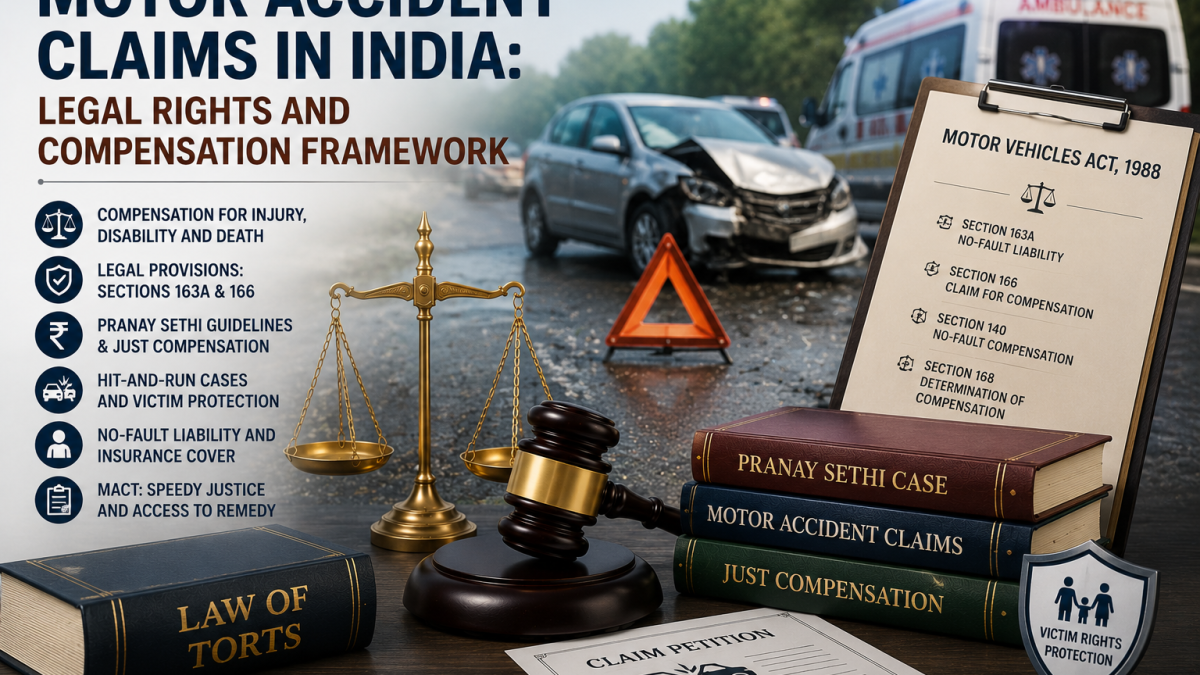
The Motor Vehicles Act, 1988 provides for compulsory third-party insurance for all motor vehicles and establishes the institutional framework of Motor Accidents Claims Tribunals for the adjudication of compensation claims. Chapter XI of the Act deals with insurance of motor vehicles against third-party risks, and Chapter XII establishes the framework for MACTs. The Act provides for two types of compensation — structured formula-based compensation under Section 163A and fault-based compensation under Section 166.
The Motor Vehicles (Amendment) Act, 2019 introduced several significant changes, including a substantial increase in the minimum compensation for hit-and-run cases, a new framework for cashless treatment of accident victims at empanelled hospitals, and the establishment of a National Road Safety Board. The amendment also introduced stricter penalties for traffic violations and enhanced the powers of transport authorities.
The Structured Formula: Section 163A Claims
Section 163A of the Motor Vehicles Act provides for compensation on a structured formula basis without the need to prove negligence, making it a no-fault liability provision. This provision was designed to provide speedy and certain compensation to road accident victims, particularly those from lower income groups who might find it difficult to establish negligence in adversarial proceedings. The Supreme Court has held that claims under Section 163A are independent of claims under Section 166 and that a victim cannot simultaneously pursue both remedies.
In National Insurance Co. Ltd. v. Pranay Sethi (2017), the Supreme Court revised the parameters for computing compensation under Section 166 and laid down comprehensive guidelines on the assessment of loss of income, future prospects, and non-pecuniary heads of compensation such as pain and suffering, loss of amenities, and loss of consortium. The Pranay Sethi judgment has become the foundational reference point for compensation calculations in motor accident cases and has brought greater uniformity to the otherwise varied decisions of different Tribunals and High Courts.
Liability of Insurer and Insured
One of the most contested areas in motor accident law is the liability of insurance companies and their defences against payment of compensation. Insurance companies often raise defences such as the absence of a valid driving licence, the use of a vehicle for a purpose not permitted by the policy, or the contributory negligence of the deceased or injured victim. Courts have adopted a pro-victim approach in interpreting these defences, holding that technical defences by insurers should not be allowed to defeat the legitimate claims of accident victims.
The Supreme Court in Swaran Singh v. State of Punjab (2004) laid down detailed guidelines on the defence of invalid or absent driving licence available to insurance companies. The Court held that an insurer can avoid liability on the ground of breach of licence conditions only if it establishes that the owner was negligent in permitting a person without a valid licence to drive the vehicle. This principle of contributory fault has been consistently applied in subsequent decisions to balance the interests of insurers and claimants.
Hit-and-Run Cases and the Solatium Fund
A significant number of road accident cases involve hit-and-run vehicles where the identity of the offending vehicle or its owner cannot be ascertained. To address this, the Motor Vehicles Act provides for compensation from the Solatium Fund in such cases. The Motor Vehicles (Amendment) Act, 2019 significantly increased the solatium amounts payable in hit-and-run cases, raising the compensation for death to Rs. 2 lakhs and for grievous injury to Rs. 50,000.
Courts have also addressed the question of whether injury due to the fall of a tree or other object on a stationary vehicle constitutes a motor accident for the purposes of the MACT Act. The Supreme Court in its 2026 judgment on motor accident compensation held that injuries caused by the fall of a roadside tree branch on a stationary autorickshaw during heavy rain do not constitute a motor accident, thereby clarifying the boundary of what constitutes a compensable motor accident under the Act.
Compensation for Homemakers
The question of compensation for the death or disability of homemakers has been a significant area of judicial development. Earlier decisions had often assigned nominal or no economic value to the contribution of homemakers, reflecting gender bias in the valuation of unpaid domestic work. The Supreme Court in Lata Wadhwa v. State of Bihar (2001) and subsequently in Arun Kumar Agarwal v. National Insurance Co. Ltd. (2010) recognized that homemakers perform valuable economic work and that their contribution must be quantified for the purpose of computing compensation.
In 2026, the Supreme Court reiterated and strengthened this principle in a judgment that cited the 2023 Handbook on Compensation which attempted to assign a standardized monetary value to the services rendered by homemakers. The Court affirmed that the loss suffered by a family due to the death of a homemaker is real and quantifiable and must be adequately compensated under the Motor Vehicles Act.
Conclusion
The legal framework governing motor accident compensation in India has evolved significantly over the past three decades, driven largely by activist judicial interpretation that has consistently prioritized the interests of accident victims over technical defences. The Supreme Court’s consistent emphasis on just and fair compensation has raised the standards of awards across the country and brought greater predictability to the process. However, the effective delivery of compensation to accident victims continues to be hampered by delays in Tribunal proceedings, inadequate insurance coverage, and the practical difficulties faced by poor and vulnerable claimants in navigating the legal system. Further reforms in institutional infrastructure and procedural simplification are needed to ensure that the right to compensation is a meaningful reality for all road accident victims.