Introduction
Family law in India is a complex and pluralistic domain governed by multiple personal laws based on religion, including the Hindu Marriage Act, the Muslim Personal Law (Shariat) Application Act, the Indian Christian Marriage Act, and the Parsi Marriage and Divorce Act. Cutting across these personal laws is the Special Marriage Act, which provides a secular framework for marriage and divorce. The judiciary has been instrumental in interpreting and reforming family law, often balancing the imperatives of constitutional equality with the sensitivities of religious and cultural tradition.
Issues of marital disputes, divorce, maintenance, custody, and matrimonial property have been among the most actively litigated areas in Indian courts. The Supreme Court and High Courts have delivered numerous landmark judgments that have progressively expanded the rights of spouses — particularly wives — within the institution of marriage. This article examines some of the most significant judicial developments in Indian family law.
Irretrievable Breakdown of Marriage: A Developing Doctrine
Indian divorce law has traditionally been based on fault grounds, requiring the petitioner to establish that the other spouse is guilty of matrimonial misconduct such as cruelty, desertion, or adultery. The concept of irretrievable breakdown of marriage — under which divorce can be granted simply because the marriage has broken down beyond repair, regardless of fault — was not recognized as a statutory ground for divorce in India until relatively recently.
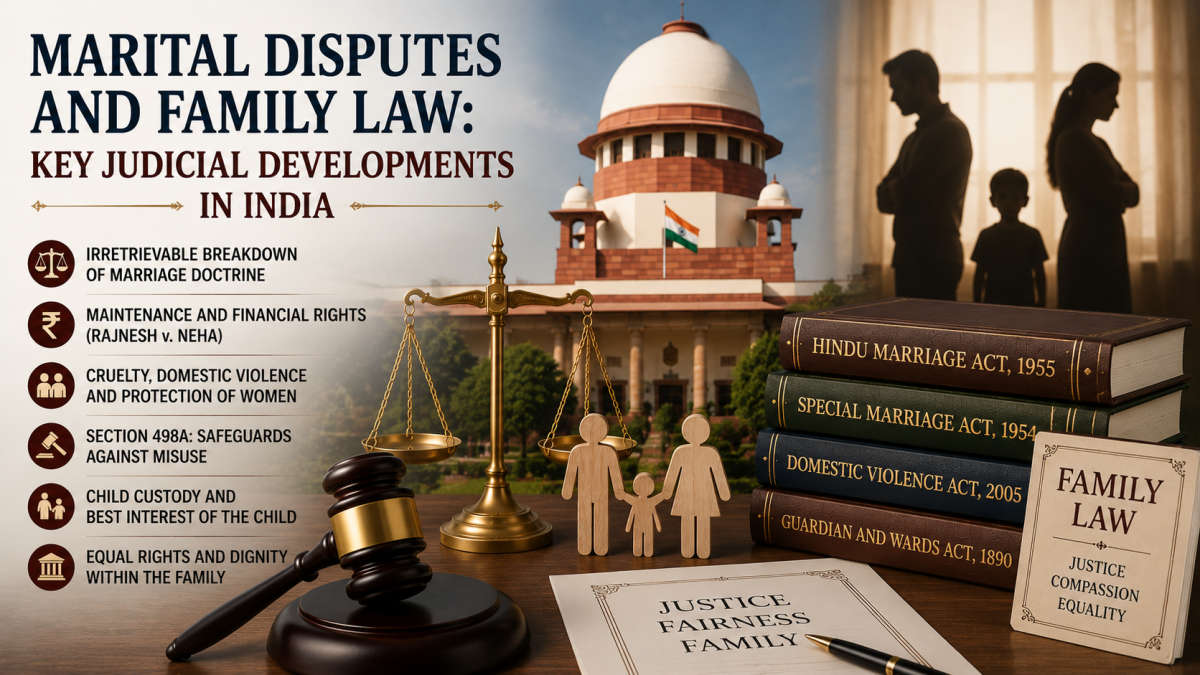
However, the Supreme Court exercised its jurisdiction under Article 142 of the Constitution to grant divorces on the ground of irretrievable breakdown of marriage in several cases, even in the absence of specific legislative provision. In Shilpa Sailesh v. Varun Sreenivasan (2023), a five-judge Constitutional Bench of the Supreme Court conclusively held that it has the power to dissolve marriages on the ground of irretrievable breakdown under Article 142, and laid down detailed guidelines for the exercise of this discretion, emphasizing that such a course should be adopted only where it is clear that the marriage has completely collapsed and there is no possibility of reconciliation.
Maintenance Rights: Section 125 CrPC and Beyond
Section 125 of the Code of Criminal Procedure (now Section 144 of the Bharatiya Nagarik Suraksha Sanhita) provides a secular and summary remedy for maintenance to wives, children, and parents who are unable to maintain themselves. The Supreme Court has consistently interpreted the provision in favour of dependent spouses and has rejected technical defences raised by husbands to avoid maintenance obligations.
In Rajnesh v. Neha (2021), the Supreme Court laid down comprehensive guidelines for the disposal of maintenance applications, including a timeline of 60 days for deciding interim maintenance applications and standardized affidavits of assets and liabilities to ensure full financial disclosure by both parties. The judgment also addressed the issue of overlapping maintenance proceedings in different courts and held that to avoid multiplicity of proceedings, only one court should have jurisdiction to hear all maintenance-related claims of a party.
Cruelty as a Ground for Divorce
The concept of cruelty as a matrimonial offence has been significantly broadened by judicial interpretation to include not just physical violence but also mental cruelty, emotional abuse, and persistent humiliation. The Supreme Court in Samar Ghosh v. Jaya Ghosh (2007) laid down a comprehensive set of principles on mental cruelty and held that whether a particular conduct constitutes cruelty must be assessed in the context of the background, social status, and sensitivity of the parties.
Courts have also held that the failure to consummate a marriage, persistent false allegations of infidelity, denial of physical intimacy without valid reason, and other forms of emotional neglect can constitute cruelty sufficient to justify dissolution of the marriage. The expanding definition of cruelty reflects the judiciary’s recognition that psychological harm within marriage is as real and as damaging as physical violence.
Section 498A IPC: Misuse and Safeguards
Section 498A of the Indian Penal Code, which criminalizes cruelty to a wife by her husband or his relatives, was enacted in 1983 as a response to the widespread problem of dowry harassment and domestic violence. However, the provision has been the subject of intense controversy, with allegations of widespread misuse to settle personal scores and to facilitate the arrest of innocent family members of the husband.
The Supreme Court in Arnesh Kumar v. State of Bihar (2014) issued stringent guidelines on arrests in Section 498A cases, directing that police officers must carry out a preliminary inquiry and satisfy themselves of the necessity of arrest before making an arrest in matrimonial dispute cases. Courts have also emphasized the need to distinguish between genuine cases of matrimonial cruelty and cases where the provision is being misused as a tool of harassment. The recent Supreme Court judgment upholding the setting aside of a Section 498A conviction in a case of mere non-communication between spouses reflects the judiciary’s commitment to ensuring that the provision is applied in its true spirit.
Child Custody: Welfare of the Child as the Paramount Consideration
In custody disputes between estranged spouses, the welfare of the child is the paramount consideration that supersedes all other considerations, including the claims of either parent. This principle, rooted in the Guardians and Wards Act, 1890, and recognized by the Supreme Court in numerous judgments, requires courts to make a holistic assessment of the physical, emotional, educational, and social needs of the child in determining custody arrangements.
Courts have recognized that joint custody arrangements and adequate visitation rights for the non-custodial parent are generally in the best interest of the child, as they allow the child to maintain meaningful relationships with both parents. The Supreme Court has also addressed the issue of international child abduction in the context of custody disputes, holding that the principle of comity of courts requires Indian courts to give due weight to the decisions of foreign courts on custody issues while ensuring that the return of the child to a foreign jurisdiction does not prejudice the child’s welfare.
Conclusion
Indian family law continues to evolve through a dynamic interplay of judicial interpretation, legislative reform, and social change. The courts have played a vital role in expanding the rights of spouses and children within the institution of marriage, often navigating the complex terrain between constitutional guarantees of equality and the diversity of personal law traditions. The challenge for Indian family law in the coming decades will be to develop a more unified and equitable framework that upholds the dignity and rights of all family members while respecting the pluralism that is central to India’s social and legal identity.