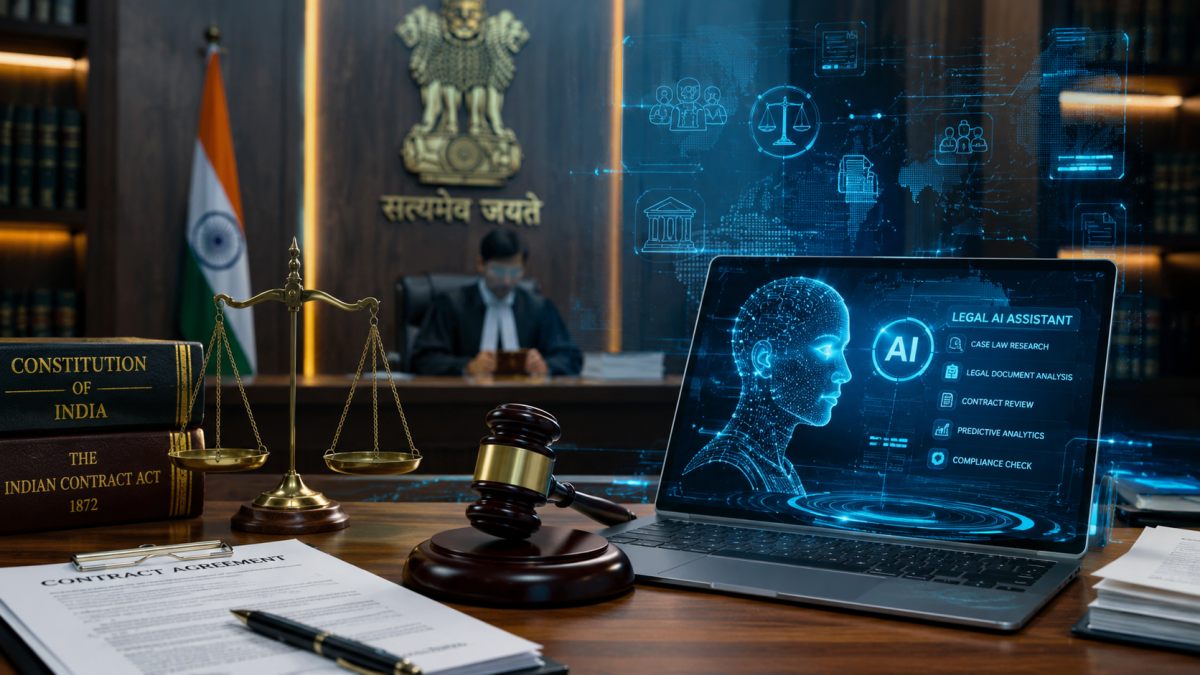
Artificial Intelligence (AI) has rapidly evolved from a futuristic concept into a practical tool reshaping industries worldwide. The legal profession, traditionally known for its reliance on extensive research and documentation, is no exception.
In India, law firms, corporate legal departments, courts, and legal technology startups are increasingly adopting AI-powered solutions to improve efficiency, reduce costs, and enhance access to legal information. While AI presents significant opportunities, it also raises important questions regarding ethics, accountability, privacy, and the future role of legal professionals.
Understanding AI in the Legal Context
Artificial Intelligence refers to computer systems capable of performing tasks that typically require human intelligence, including:
- Natural language processing
- Pattern recognition
- Predictive analysis
- Data classification
- Document review
Modern AI systems can analyze large volumes of legal information within seconds, significantly reducing the time traditionally spent on manual review.
AI-Powered Legal Research
One of the most significant applications of AI in law is legal research.
Lawyers routinely analyze:
- Statutes
- Judicial precedents
- Regulatory notifications
- Government circulars
AI-powered legal research platforms can:
- Identify relevant judgments
- Summarize case law
- Detect legal patterns
- Suggest related authorities
This enables legal professionals to focus more on strategy and analysis rather than information retrieval.
Contract Review and Due Diligence
Corporate legal work often involves reviewing large volumes of contracts.
AI tools can assist by:
- Identifying unusual clauses
- Flagging compliance risks
- Detecting inconsistencies
- Comparing contractual provisions
These capabilities are particularly useful during mergers, acquisitions, financing transactions, and compliance reviews.
However, final legal interpretation continues to require human oversight.
AI and Litigation Support
AI is increasingly being used to support litigation teams.
Applications include:
Case Analysis
AI systems can examine prior decisions and identify relevant precedents.
Document Management
Large litigation matters often involve thousands of pages of records.
AI can assist in organizing, indexing, and retrieving relevant documents.
Predictive Analytics
Some advanced platforms attempt to analyze historical case outcomes and identify litigation trends.
Such tools are intended to assist legal strategy rather than replace judicial decision-making.
Impact on Corporate Compliance
Businesses face growing compliance obligations involving:
- Data protection
- Employment laws
- Environmental regulations
- Financial reporting
AI-powered compliance systems can monitor regulatory changes and generate alerts regarding potential risks.
This helps organizations improve governance and reduce compliance failures.
AI in the Indian Judiciary
Indian courts have also explored technology-driven solutions.
Examples include:
- E-Courts initiatives
- Digital case management systems
- Translation tools
- Electronic filing systems
The Supreme Court of India has previously experimented with AI-assisted tools for legal research and document management.
Such initiatives aim to improve efficiency without replacing judicial discretion.
Ethical and Legal Concerns
Despite its benefits, AI raises several concerns.
Accuracy and Reliability
AI-generated outputs may occasionally contain errors or inaccurate legal interpretations.
Legal professionals remain responsible for verifying information before relying upon it.
Data Privacy
Many AI systems process large amounts of personal and confidential information.
This raises important questions regarding:
- Data security
- Confidentiality
- Compliance with privacy laws
Bias and Fairness
AI systems learn from existing data.
If training data contains biases, outcomes may reflect those biases.
Ensuring fairness and transparency remains a key challenge.
Will AI Replace Lawyers?
The short answer is no.
While AI can automate repetitive and data-intensive tasks, many aspects of legal practice require:
- Professional judgment
- Strategic thinking
- Negotiation skills
- Advocacy
- Ethical decision-making
Clients often seek legal advice involving complex factual, commercial, and human considerations that extend beyond technical analysis.
AI is therefore more likely to function as an assistive tool rather than a replacement for lawyers.
Opportunities for Young Lawyers
Rather than viewing AI as a threat, young legal professionals can benefit by developing technological competence.
Skills likely to gain importance include:
- Legal technology literacy
- Data privacy compliance
- Technology law
- Cybersecurity regulation
- AI governance
Lawyers who understand both law and technology may enjoy significant professional advantages in the coming years.
The Regulatory Landscape
Governments and regulators worldwide are increasingly examining the legal implications of AI.
Key issues include:
- Liability for AI-generated decisions
- Intellectual property concerns
- Consumer protection
- Algorithmic transparency
- Regulatory oversight
India is expected to continue developing policies addressing emerging technological challenges.
Conclusion
Artificial Intelligence is transforming legal practice by improving efficiency, expanding access to information, and reducing administrative burdens. From legal research and contract analysis to compliance monitoring and litigation support, AI is becoming an important component of modern legal services.
However, technology cannot replace the professional judgment, ethical responsibility, and human insight that remain central to the legal profession. The future of law is likely to involve collaboration between legal expertise and technological innovation rather than substitution.
For Indian lawyers, embracing AI while maintaining professional standards may be the key to success in an increasingly digital legal landscape.
Sources
- Supreme Court of India technology initiatives.
- E-Courts Mission Mode Project.
- Ministry of Electronics and Information Technology (MeitY).
- Bar Council of India publications.
- International Bar Association reports on AI and legal services.
Disclaimer: This article is intended for informational purposes only and does not constitute legal advice.