Introduction
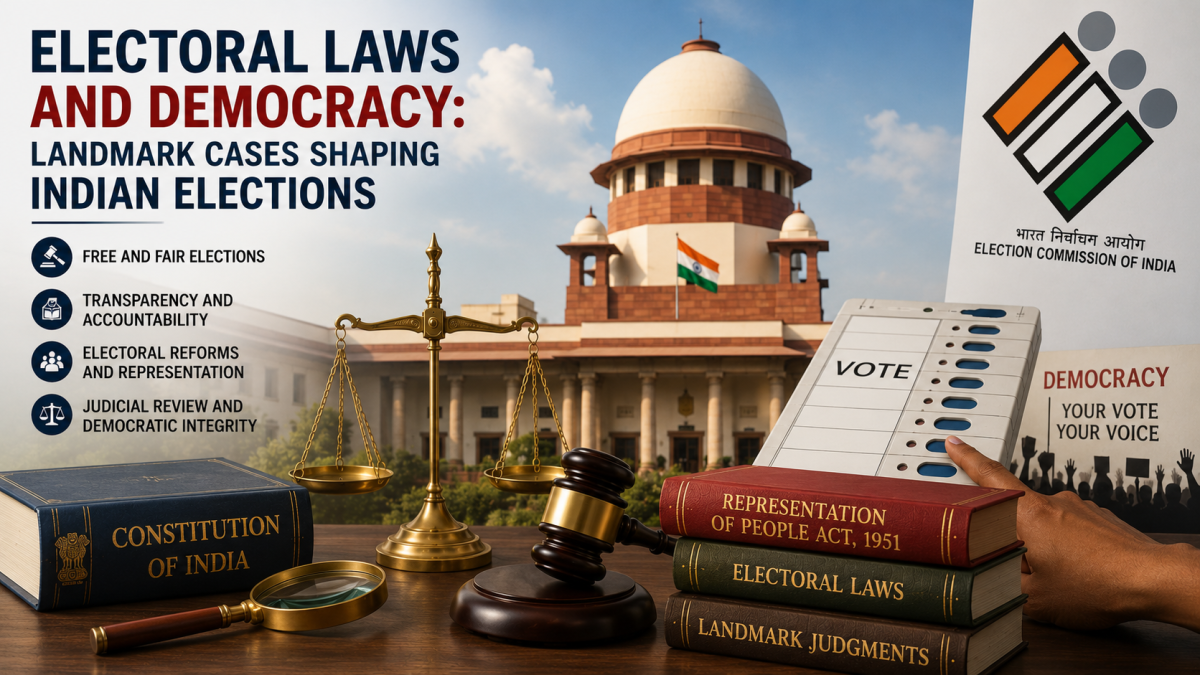
Free and fair elections are the lifeblood of a democratic republic, and the legal framework governing elections in India is one of the most comprehensive and frequently litigated areas of constitutional law. The Constitution of India provides the foundational framework for the electoral system, vesting superintendence, direction, and control of elections in the Election Commission of India, an independent constitutional body. The Representation of the People Act, 1950 and the Representation of the People Act, 1951 govern the mechanics of elections, disqualifications, and electoral disputes.
The Supreme Court and High Courts have delivered numerous landmark judgments on electoral law that have shaped the integrity and fairness of India’s democratic process. These judgments have addressed issues ranging from the right to vote and the disqualification of candidates to campaign finance, the use of religion and caste in elections, and the powers of the Election Commission. This article examines some of the most significant judicial developments in the law governing Indian elections.
The Right to Vote: A Constitutional Right
The right to vote is the foundational right of democratic citizenship, and the Supreme Court has affirmed that it is a constitutional right protected under the Constitution, even though it is not expressly listed as a fundamental right. In People’s Union for Civil Liberties v. Union of India (2003), the Supreme Court held that the right to know about the background of candidates standing for election — including their criminal antecedents, educational qualifications, and financial status — is part of the right to vote in a meaningful sense. The Court directed the Election Commission to require candidates to disclose this information in their nomination papers, a ruling that has had a profound impact on electoral transparency.
In Lily Thomas v. Union of India (2013), the Supreme Court struck down Section 8(4) of the Representation of the People Act, 1951, which allowed convicted legislators to continue in office pending their appeal against conviction, holding that it was unconstitutional and discriminatory. The judgment has resulted in the automatic disqualification of sitting legislators upon conviction for offences attracting imprisonment of two years or more.
Criminalisation of Politics: A Growing Challenge
The growing presence of persons with criminal records in legislative bodies has been a matter of grave concern for Indian democracy. The Supreme Court has been at the forefront of efforts to address the criminalization of politics, delivering a series of judgments aimed at strengthening the disqualification provisions and transparency requirements applicable to candidates and legislators.
In Public Interest Foundation v. Union of India (2018), the Supreme Court directed that candidates with pending criminal cases must publish information about their criminal antecedents prominently in newspapers and on social media, and that political parties must also publicize why they have given tickets to candidates with criminal records. The Court stopped short of directing that persons with pending criminal cases should be disqualified from contesting elections, holding that this was a matter for Parliament to legislate upon.
Election Commission: Independence and Powers
The Election Commission of India is a constitutional body vested with plenary powers to supervise and control elections. The Supreme Court has consistently upheld and strengthened the independence and powers of the Election Commission, holding in Mohinder Singh Gill v. Chief Election Commissioner (1978) that the Election Commission has residual power to take all steps necessary for the conduct of free and fair elections, even in situations not expressly covered by the statute.
However, the appointment process for Election Commissioners became a matter of significant legal controversy. In Anoop Baranwal v. Union of India (2023), a five-judge Constitutional Bench of the Supreme Court held that Election Commissioners should be appointed by a committee comprising the Prime Minister, the Leader of the Opposition, and the Chief Justice of India, rather than by executive appointment alone. This landmark judgment sought to protect the independence of the Election Commission from executive influence, though it was subsequently modified by legislation passed by Parliament in 2023.
Electoral Bonds and Campaign Finance
The financing of election campaigns has been one of the most opaque and contentious aspects of Indian electoral democracy. The Electoral Bond Scheme, introduced in 2018, allowed companies and individuals to purchase bonds from the State Bank of India and donate them anonymously to political parties. The scheme was challenged before the Supreme Court on the ground that anonymous political funding was antithetical to the constitutional right of voters to know about the sources of funding of political parties.
In a landmark judgment in February 2024, the Supreme Court struck down the Electoral Bond Scheme as unconstitutional, holding that the right to information about political funding is part of the fundamental right to freedom of expression under Article 19(1)(a) of the Constitution. The Court directed the State Bank of India to disclose information about all bonds purchased and redeemed, resulting in the public disclosure of details of donors and recipient parties for the first time. The judgment was a watershed moment for transparency in electoral finance in India.
Religion and Caste in Elections: The Hindutva Cases
The use of religion and caste in election campaigns has been a deeply divisive issue in Indian electoral law. Section 123 of the Representation of the People Act, 1951 prohibits the use of religion, race, caste, community, or language as a ground for seeking votes or prejudicing an election. The Supreme Court in Dr. Ramesh Yeshwant Prabhoo v. Prabhakar Kashinath Kunte (1995) interpreted these provisions in the context of speeches and campaign material that invoked Hindutva, holding that the term Hindutva referred to a way of life rather than a religious creed and that references to it did not necessarily constitute a corrupt electoral practice.
This interpretation was revisited in Abhiram Singh v. C.D. Commachen (2017), where a seven-judge bench of the Supreme Court held by a 4:3 majority that the prohibition on appealing to religion, race, caste, community, or language applies not only to the religion of the voters but also to the religion of the candidate, the candidate’s agent, or any other person. The dissenting minority held a narrower view, and the precise contours of what constitutes a corrupt electoral practice involving religion and caste continue to be contested.
Conclusion
Electoral law is the foundation of democratic governance, and the judicial oversight of elections is essential to maintaining the integrity of the democratic process in India. The Supreme Court and High Courts have played a critical role in expanding transparency, curbing the criminalization of politics, and protecting the independence of the Election Commission. However, many challenges remain, including the influence of money power, the misuse of state machinery, and the slow pace of electoral reforms. A truly vibrant democracy requires not only robust electoral laws and institutions but also an engaged citizenry that demands accountability from those who seek to represent them.