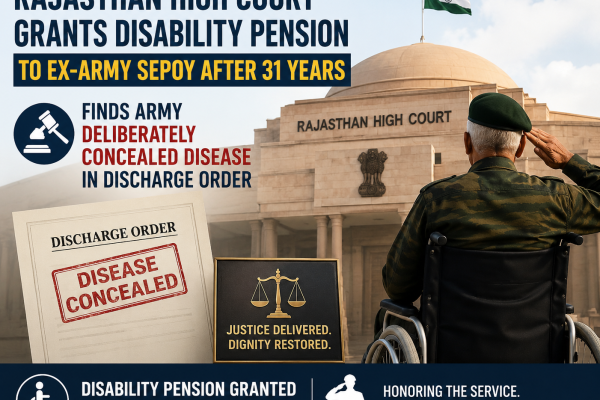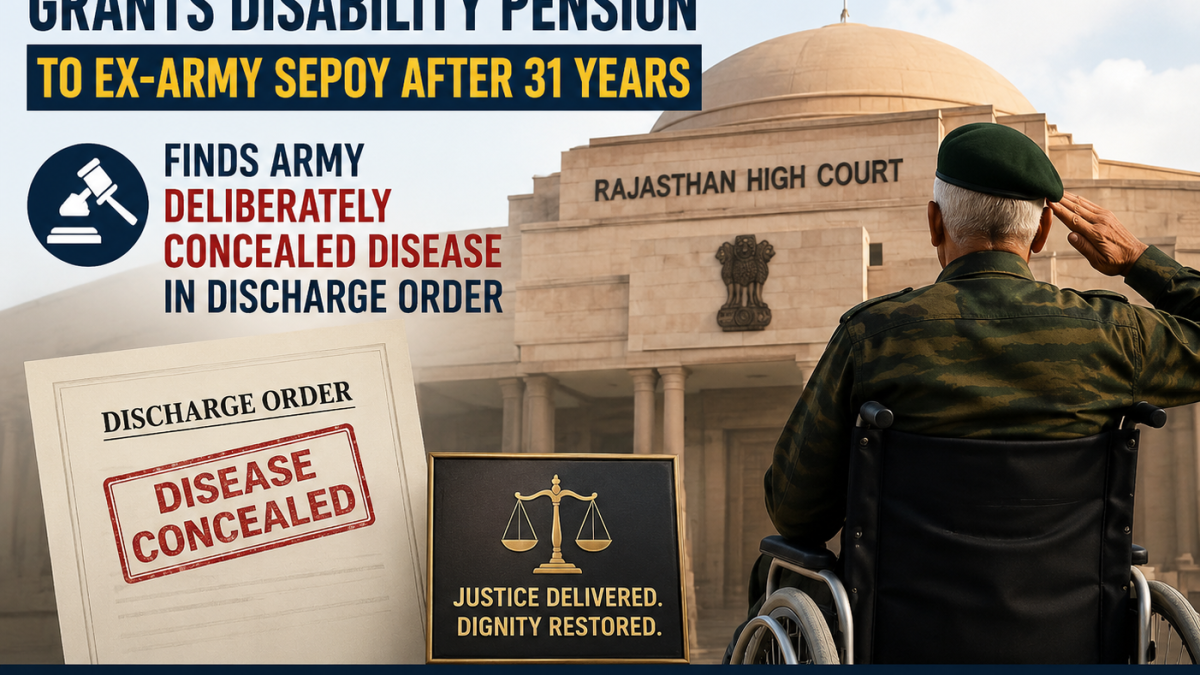
The Rajasthan High Court has granted relief to a former Indian Army Sepoy after 31 years of his discharge in 1995, directing that he be paid disability/invalid pension. The Court found that no medical examination was conducted prior to his discharge, and that his neurological disease was deliberately not disclosed in the discharge order.
Background
The petitioner had served in the Indian Army and was discharged in 1995 on grounds of medical unfitness owing to a neurological condition he developed during his service. Despite developing the condition while in service — which would ordinarily entitle him to disability pension — he was denied such benefit.
Upon discharge, his medical history was not recorded in the discharge order. He spent decades fighting for the pension he was legally entitled to. After exhausting administrative remedies without success, he approached the Rajasthan High Court.
High Court’s Findings
The Rajasthan High Court found serious lapses on the part of the Army. The Court noted that no medical examination was conducted before or at the time of his discharge, which was a mandatory requirement under the applicable rules. Moreover, the Court observed that the ex-Sepoy’s disease was “deliberately” left undisclosed in the discharge order — an act that the Court found deeply concerning.
The High Court held that a soldier who develops a disability in the course of service cannot be denied disability pension on the basis of an incomplete or misleading discharge order. It directed the authorities to grant the pensionary benefits to the petitioner.
Legal Framework
Under the Army Rules, 1954, and the relevant pension regulations, a person who sustains a disability attributable to or aggravated by military service is entitled to disability pension. The Supreme Court has in several cases held that the right to pension of defence personnel must be construed liberally in favour of soldiers who served the nation.
Significance
This case highlights the plight of defence personnel who are denied legitimate pension benefits due to administrative lapses or deliberate omissions at the time of discharge. The judgment reaffirms the High Court’s commitment to upholding the rights of veterans and ensuring that the sacrifices made by soldiers are recognised and rewarded.
Court: Rajasthan High Court | Source: LiveLaw | June 2026